
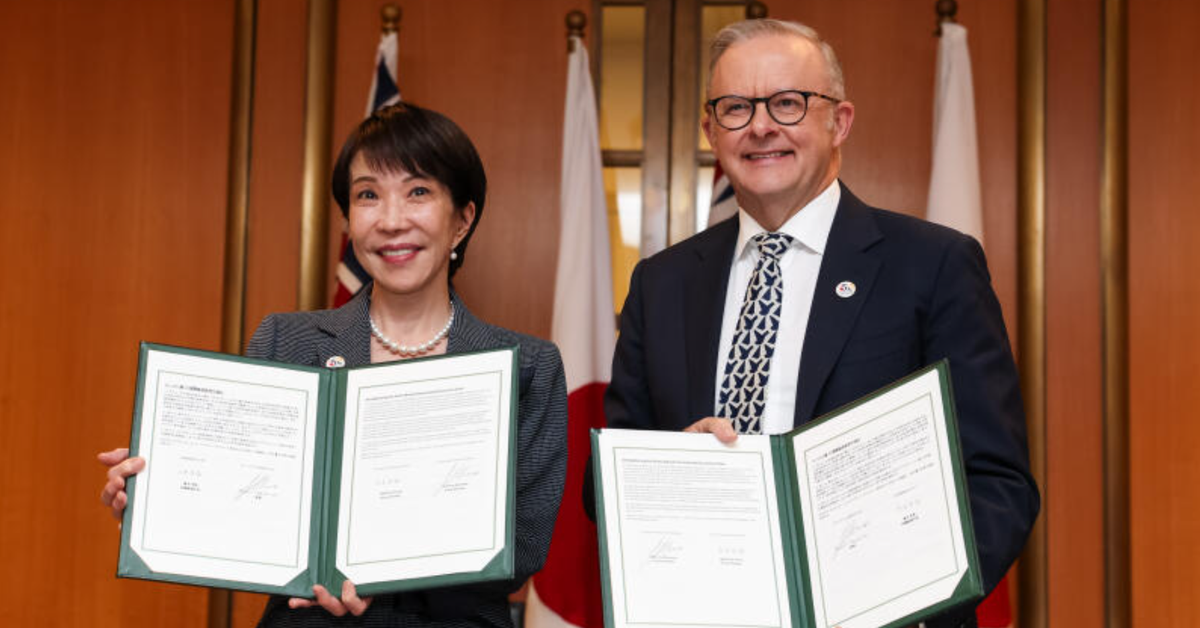
Australia and Japan have committed to bolstering their economic, energy, and defence partnerships in light of the ongoing crises stemming from the conflict in the Middle East. This renewed cooperation was celebrated today as Prime Minister Anthony Albanese and Japanese Prime Minister Takaichi Sanae signed a Joint Declaration on Economic Security and Cooperation, marking 50 years of diplomatic relations.
The agreement aims to create “trusted” supply chains for vital resources such as fuel, energy, critical minerals, food, and technology between the two nations. Albanese highlighted that this collaborative effort is essential for maintaining trade flows of significant energy commodities, specifically liquid fuels and gas, particularly during the current energy crisis.
“In light of global disruptions like those caused by the Middle Eastern conflict, this partnership will reduce our vulnerability,” Albanese stated, underscoring the benefits for Australian farmers and commuters. He noted that securing more fuel shipments from allied nations is a priority, especially following disruptions linked to the conflict in Iran, which has impacted Australian fuel imports predominantly sourced from Asian markets.
While Australia receives a fraction of its fuel from Japan, it supplies approximately 40% of Japan’s liquefied natural gas. In addition to addressing energy security, the recent accords between Australia and Japan also encompass agreements on critical minerals, defence collaboration, and a commitment to a stable Indo-Pacific region.
Both leaders expressed their dedication to strengthen ties, with Albanese remarking that their friendship has never been stronger, particularly in these uncertain times. Takaichi echoed this sentiment, describing their discussions as “highly productive” and expressing confidence that their partnership will thrive over the next five decades. She noted that Japan and Australia are at the forefront of fostering cooperation among nations with shared values and interests, achieving a level of security cooperation that borders on being quasi-allies.
The importance of collaboration was further emphasised by Takaichi, who acknowledged the regional implications of issues like the closure of the Strait of Hormuz. She affirmed that both countries would maintain close communication to bolster their resilience in responding to these challenges.
As Australia’s third-largest trading partner and second-largest export market, Japan plays a critical role in Australia’s economic landscape. This partnership is set to deepen, further illustrated by a recent $10 billion agreement in April for Japan to supply three upgraded Mogami-class frigates to the Royal Australian Navy by 2029.
The commitment to mutual support and cooperation is clear, positioning both nations to navigate future uncertainties with greater assurance.