
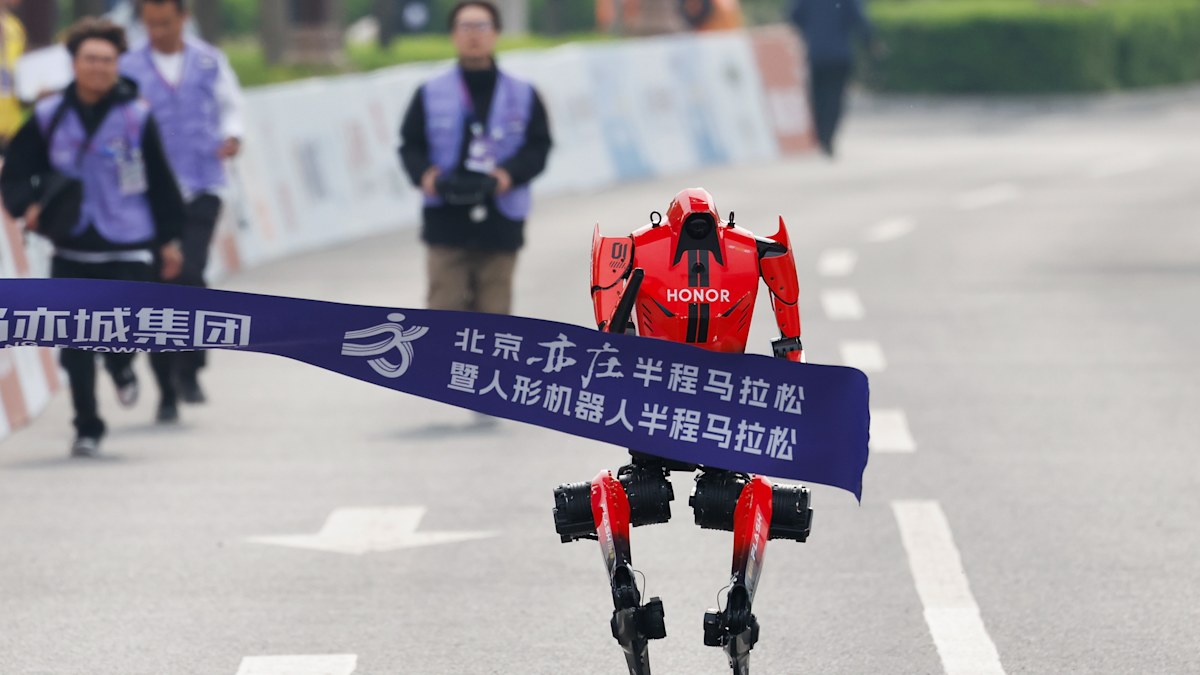
In a remarkable demonstration of technological advancement, a humanoid robot named “Blitz,” developed by Chinese smartphone manufacturer Honor, won a half-marathon race in Beijing, finishing the 21-kilometre course in 50 minutes and 26 seconds. This achievement surpasses the human world record for the same distance, previously held by Uganda’s Jacob Kiplimo, who completed it in approximately 57 minutes at the Lisbon road race in March.
The event showcased significant progress from last year’s inaugural race, where the top robot’s completion time was a staggering 2 hours and 40 minutes. Despite a few technical glitches during the race—such as robots stumbling or colliding with barriers—the overall performance was a testament to advancements in robotics. Du Xiaodi, a test development engineer at Honor, expressed satisfaction with the results, noting that the robot’s design draws inspiration from human athletes, featuring elongated legs and a custom-built liquid-cooling system to enhance performance.
Spectators, including families watching from the sidelines, observed a noticeable transformation in the competition dynamics. Many echoed sentiments of surprise and intrigue, as this was the first instance where robots demonstrated superior speed compared to humans. One onlooker, Sun Zhigang, remarked on the extraordinary progress made within a year, highlighting that it was a milestone where robots have officially outperformed human athletes.
During the race, approximately 40% of the competing robots navigated autonomously, while others were controlled remotely. Though another remotely operated robot finished ahead of Blitz at 48 minutes and 19 seconds, Blitz claimed victory under the event’s scoring rules, which favoured autonomous capabilities.
The event reflects China’s increasing focus on advancing technological innovation amid global competition, particularly with the United States. China’s latest five-year plan underscores the prioritisation of breakthroughs in science and technology, aiming to speed up the development of products, including humanoid robots.
Recognition of the Chinese robotics sector’s growing prowess is evident, with recent rankings identifying several companies as leading players in the market for general-purpose intelligent robots. These advancements not only signify strides in robotics but also hint at potential applications across various industries in the future.
As the race concluded, discussions about the implications of such rapid technological progress were prominent, signalling what many believe could be the dawn of a new era in robotics, one in which machines could soon play roles previously reserved for humans.