
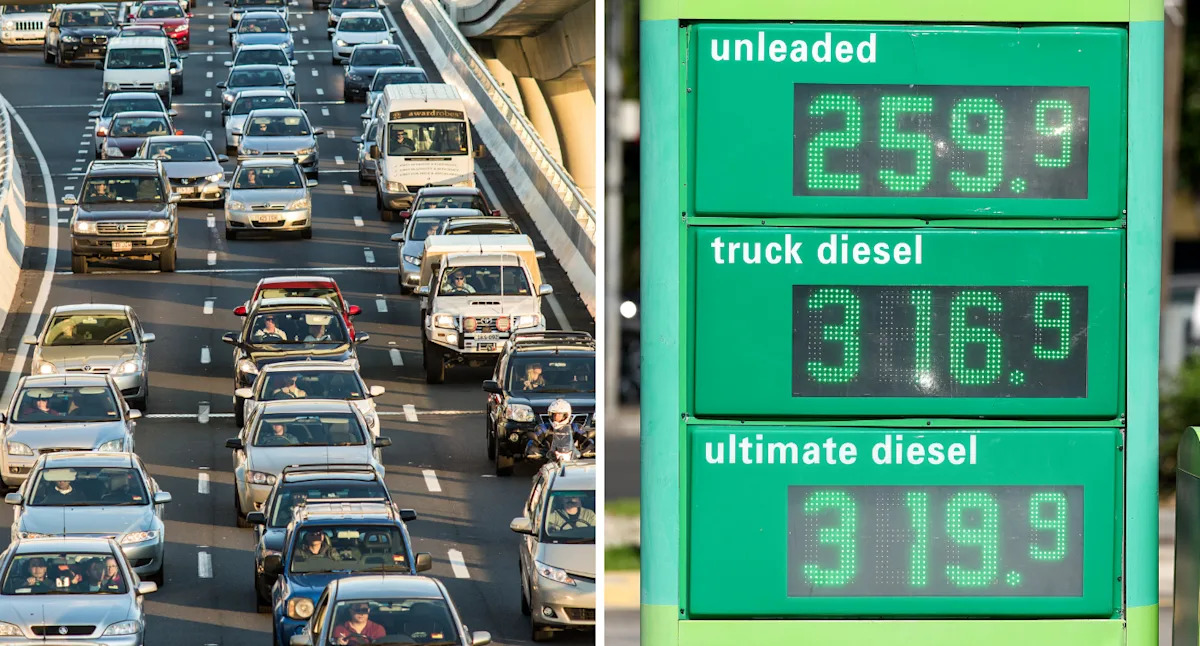
Australia’s top fuel-efficient vehicles have been identified, revealing that larger cars can sometimes be more economical than smaller models. Amid escalating petrol and diesel prices linked to the ongoing conflict in the Middle East, drivers are keenly seeking ways to save on fuel costs.
The 2022 Audi Q5 has emerged as the most fuel-efficient non-hybrid vehicle, achieving an impressive 5.6 litres per 100 kilometres. This result was derived from tests conducted by the Royal Automobile Club of Queensland (RACQ) and the Australian Automobile Association, which evaluated 152 popular car models.
Close behind is the 2023 Kia Sorento, a large SUV that delivered 6 litres per 100 kilometres in real-world conditions. The list also features the 2025 Hyundai Santa Fe and 2022 Hyundai Tucson, along with smaller vehicles such as the 2024 Hyundai i30, 2022 Toyota Corolla, and 2021 Mazda 3, all demonstrating commendable fuel efficiency.
Andrew Kirk, a principal technician researcher at RACQ, emphasised the benefits of selecting an efficient vehicle, especially during these times of high fuel costs. He pointed out that many are surprised to find the most efficient cars aren’t necessarily the smallest ones. These insights stem from practical testing that mirrors real-world performance, moving beyond standard lab results.
In the hybrid category, Toyota took the lead, securing all top five positions, with the 2024 Toyota Yaris Hybrid consuming just 3.6 litres per 100 kilometres. Additionally, for electric vehicles, the 2025 Kia EV3 showcased the longest battery range, reaching 537 kilometres from a single charge.
Despite the federal government’s recent reduction in fuel excise by 26.3 cents per litre, petrol prices remain significantly elevated compared to pre-conflict levels. The average price of unleaded petrol has risen by 82.4 cents per litre since mid-February, while diesel prices have surged by 129.8 cents per litre.
The following is a summary of Australia’s most fuel-efficient non-hybrid vehicles, showing their fuel consumption rates:
- 2022 Audi Q5 – 5.6L/100km
- 2023 Kia Sorento – 6L/100km
- 2025 Hyundai Santa Fe – 6.2L/100km
- 2022 Hyundai Tucson – 6.2L/100km
- 2024 Hyundai i30 – 6.2L/100km
- 2022 Toyota Corolla – 6.2L/100km
- 2021 Mazda 3 – 6.2L/100km
These insights and rankings encourage consumers to make informed vehicle choices that could lead to significant savings on fuel over time.