
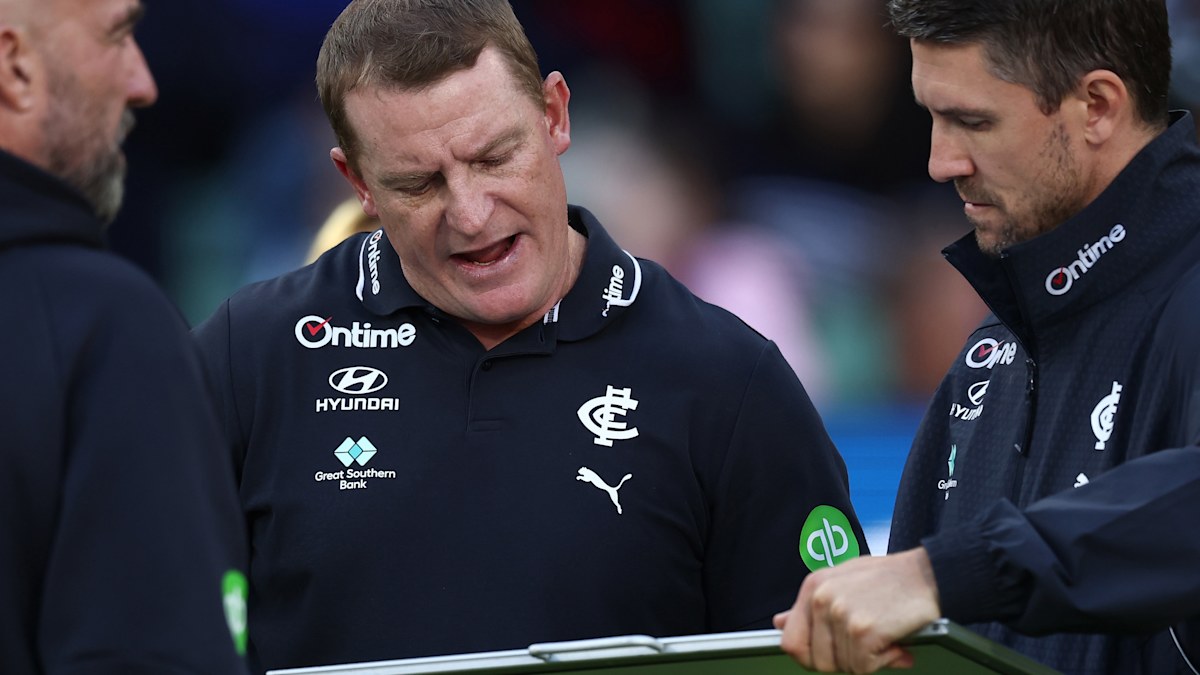
AFL legend Jimmy Bartel has expressed concerns that Carlton coach Michael Voss may be complicating his half-time instructions as the team struggles with a critical issue. Carlton’s trend of losing focus after the break appears to be worsening, highlighted by a recent match where they threw away a 43-point lead against Melbourne to ultimately lose by 23. Previous games this season reflect a similar pattern, where they lost dominance in second halves, notably against the Swans, despite leading at half-time.
The statistics reveal a concerning trend; over the last two seasons, Carlton has averaged just 34.5 points in second halves, ranking third lowest in the league. Following the defeat to Melbourne, former player Brendan Fevola hinted at the possibility of Voss’s dismissal if they falter against North Melbourne on Good Friday. Meanwhile, Essendon legend James Hird noted that players may be grappling with doubts about their ability to maintain performance over four quarters.
Hird suggested that Voss should direct the team’s focus to one quarter at a time rather than overwhelming players with strategies for the entire match. Bartel echoed this sentiment, advocating for a simplified approach to half-time messaging. He believes that reducing the number of focus points for players to just two or three might improve concentration and performance in the third quarter.
Bartel pointed out that while Carlton often gets numbers around the ball, they risk losing opportunities by kicking hurriedly instead of using handball to better control the game. He urged the team to refine their technique by using handball to maintain possession and allow for strategic plays, particularly in stoppages.
As Carlton currently sits near the bottom of the AFL ladder with just one win from three matches, they face a critical test against the rejuvenated Kangaroos on Good Friday, followed by challenging games against Adelaide and Collingwood in the weeks ahead. With mounting pressure on Voss and the team, the focus will be on making the necessary adjustments to address their second-half slump.