
If global oil supplies were to cease suddenly, Australia’s circumstances would differ significantly from those of other nations, and recent statistics reveal some unsettling truths about its fuel reserves. Despite this, the federal government maintains that the nation’s fuel supply is presently secure, citing the replacement of six cancelled shipments with additional ones.
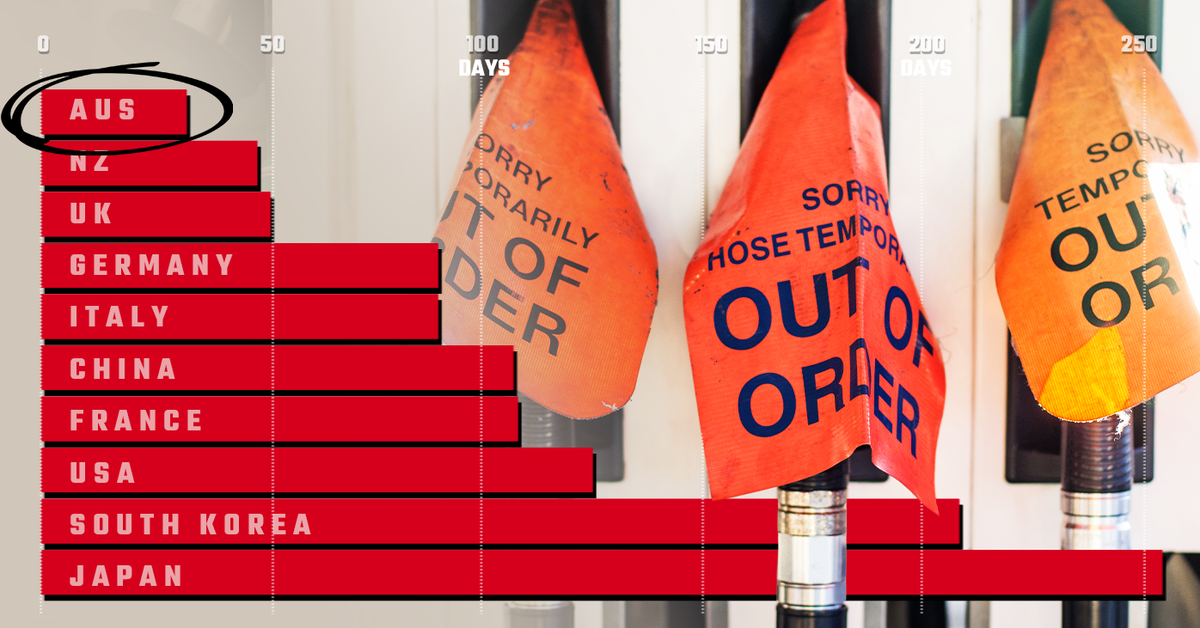
Currently, Australia is required by its membership in the International Energy Agency (IEA) to stockpile a minimum of 90 days’ worth of fuel. However, instead of maintaining a national strategic reserve, the government mandates that oil companies keep “minimum stock holdings” as emergency reserves. At the close of last year, Australia held only 38 days’ worth of petrol, 32 days of diesel, and 29 days of jet fuel—well below the IEA requirement. These levels have not significantly changed since the onset of the war in Ukraine.
In stark contrast, countries like Japan and South Korea boast extensive reserves, with Japan holding 254 days’ worth of oil. The United States, despite having reduced its reserves due to recent measures, still maintains approximately 125 days’ supply. Comparatively, Australia’s fuel storage is deficient, with many countries in Europe legally mandated to keep at least 90 days’ worth of oil on hand.
While Australia is not alone in its inadequate stockpile—New Zealand has under 50 days and Canada lacks a strategic reserve—it currently has the lowest oil holdings among IEA members. Australia’s failure to meet the 90-day obligation has persisted for over a decade, with Energy Minister Chris Bowen explaining that maintaining such reserves would cost around $20 billion over four years. He argues that this expenditure could be better allocated towards essential services like healthcare and education.
Despite criticisms, Bowen asserts that Australia is better equipped now than in the past, measuring its current reserves against prior years. Notably, he stated that the existing stocks are “more than we’ve had previously.” Nonetheless, experts recommend a larger reserve due to Australia’s heavy reliance on imported refined petroleum.
As Australia continues to draw from various suppliers in the region, it runs the risk of being affected by broader supply disruptions, as outlined by Professor Sajid Anwar from the University of the Sunshine Coast. With the country holding only around 30 days of fuel stocks compared to the advised 90 days, the ongoing situation necessitates a careful assessment of its energy strategy in light of potential global instability.